
Research / Grants and projects / Palm glycerol to lactic acid
OngoingPalm glycerol to lactic acid
Sustainable technology for the electroconversion of palm-derived glycerol into lactic acid with hydrogen co-production using nickel alloy catalysts
What the project is about
Indonesia is the world's largest producer of palm oil, and its biodiesel programme leaves behind a growing surplus of glycerol. About one tonne of crude glycerol comes out with every ten tonnes of biodiesel, and it sells for very little. This project turns that by-product into two products of higher value in a single electrochemical cell: lactic acid, the building block of the bioplastic PLA, and hydrogen.
Lactic acid is usually made by fermenting sugars, which is slow and needs complex separation, while hydrothermal routes need high temperature and pressure. Electrochemical conversion runs at room temperature and pressure. Most catalysts reported so far rely on precious metals, so we develop nickel alloy catalysts that could do the same work at lower cost.
Glycerol from biodiesel
Crude glycerol is the main by-product of palm biodiesel. It sells for roughly a tenth of the price of lactic acid.
One cell, two reactions
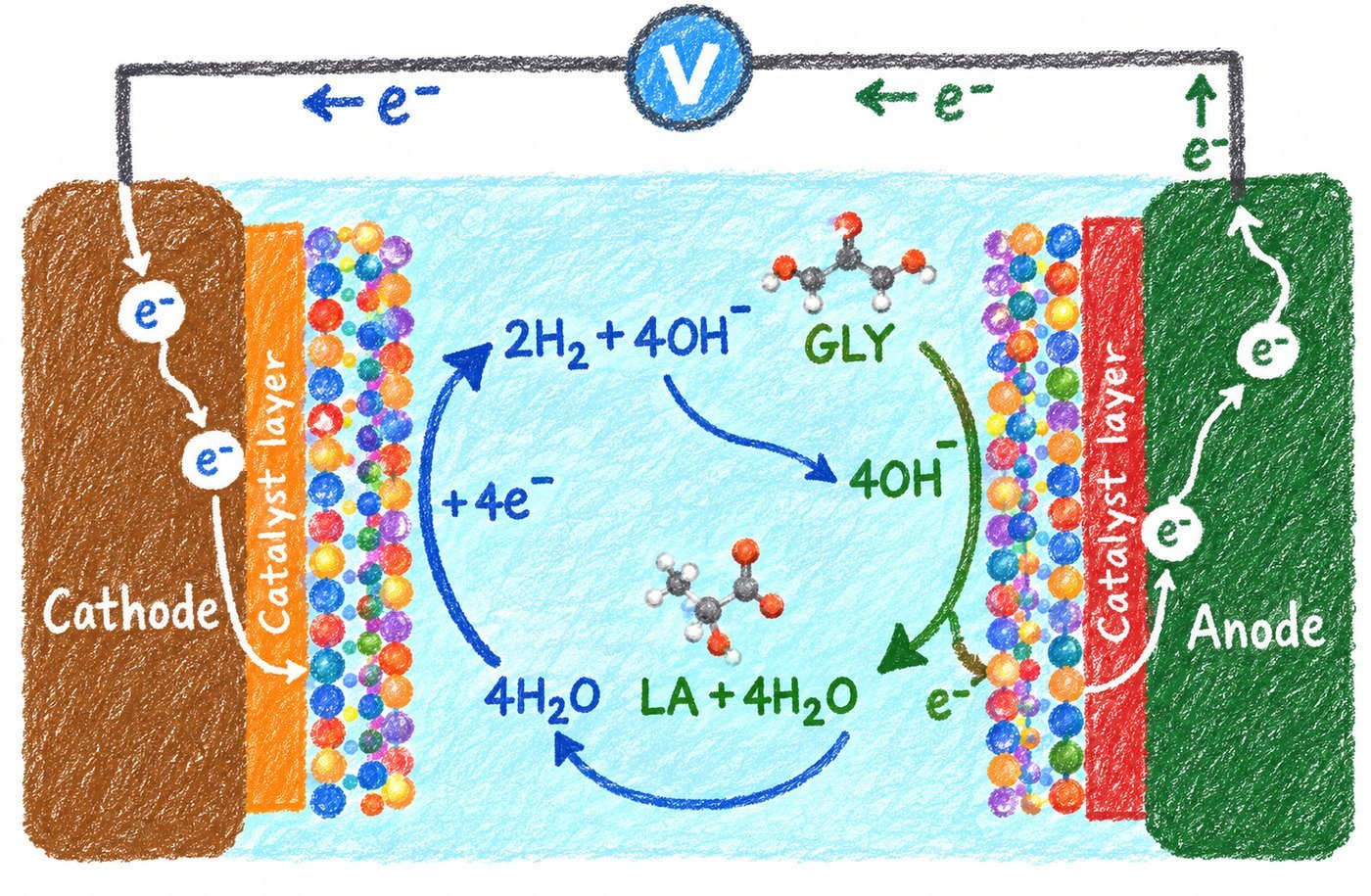
At the anode, a nickel alloy catalyst oxidizes glycerol to lactic acid. At the cathode, water is reduced to hydrogen.
Lactic acid and hydrogen
Lactic acid goes into bioplastics, food, and pharmaceuticals. Hydrogen is compressed and stored as a clean fuel.
How the cell works
In ordinary water electrolysis the anode makes oxygen, which has little value and takes a large share of the electricity. Here the oxidation of glycerol takes its place.
Glycerol oxidizes more easily than water, so the cell may need less electricity for each kilogram of hydrogen, and the anode gives a product worth selling instead of oxygen.
The project aims for a lactic acid selectivity above 80% and a hydrogen production efficiency above 90%.
Objectives
- Develop and characterize bimetallic and trimetallic nickel alloy catalysts for the electroconversion of glycerol into lactic acid.
- Understand the reaction mechanism of glycerol conversion with hydrogen co-production on these catalysts, by experiment and by density functional theory (DFT).
- Design a high-pressure hydrogen storage system that is integrated with the electroconversion process.
- Evaluate the sustainability of the whole process by life cycle assessment.
Why it matters
Economy
Adds value to a low-priced by-product of the palm biodiesel industry, and brings a second source of income from hydrogen.
Environment
Reduces glycerol waste and supplies the raw material for biodegradable PLA plastics, in line with Indonesia's net zero emissions target for 2060.
Technology
Nickel alloys could reduce the dependence on precious metal catalysts. Indonesia has abundant resources of both palm oil and nickel, which may help the step from laboratory to industry.
Policy
Supports the national palm oil research roadmap, bioenergy policy, and the role of hydrogen in the energy transition.
Project facts



Three-year roadmap
Bimetallic catalysts and cell design
Make nickel alloys with one partner metal, study how glycerol reacts on them by experiment and DFT, test them in a batch tandem cell, and design the flow cell.
Trimetallic catalysts and the flow cell
Add a third metal to the best alloys, test them in the tandem flow cell, and build a prototype tank for high-pressure hydrogen storage.
Integration and scale-up
Connect a scaled-up flow cell to hydrogen compression and storage, test the integrated system at laboratory and semi-pilot scale, and assess it for industrial use.
Life cycle and techno-economic assessment runs alongside, first at laboratory scale and then at industrial scale.
From the flow cell to stored hydrogen
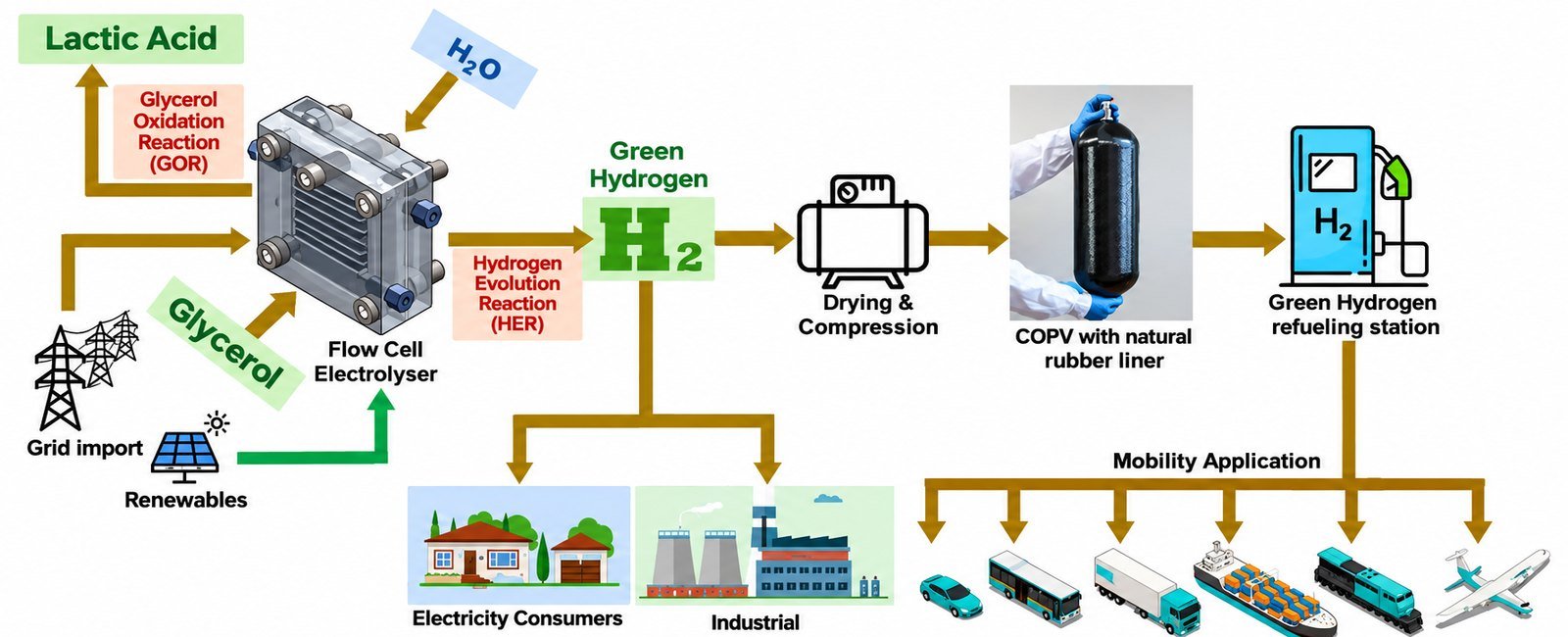
The hydrogen that leaves the flow cell is dried, compressed, and stored in a composite overwrapped pressure vessel (COPV), a lightweight tank wound from carbon fibre. The team is developing a version with a natural rubber liner. In the longer term, the stored hydrogen could serve electricity, industry, and transport.
Team
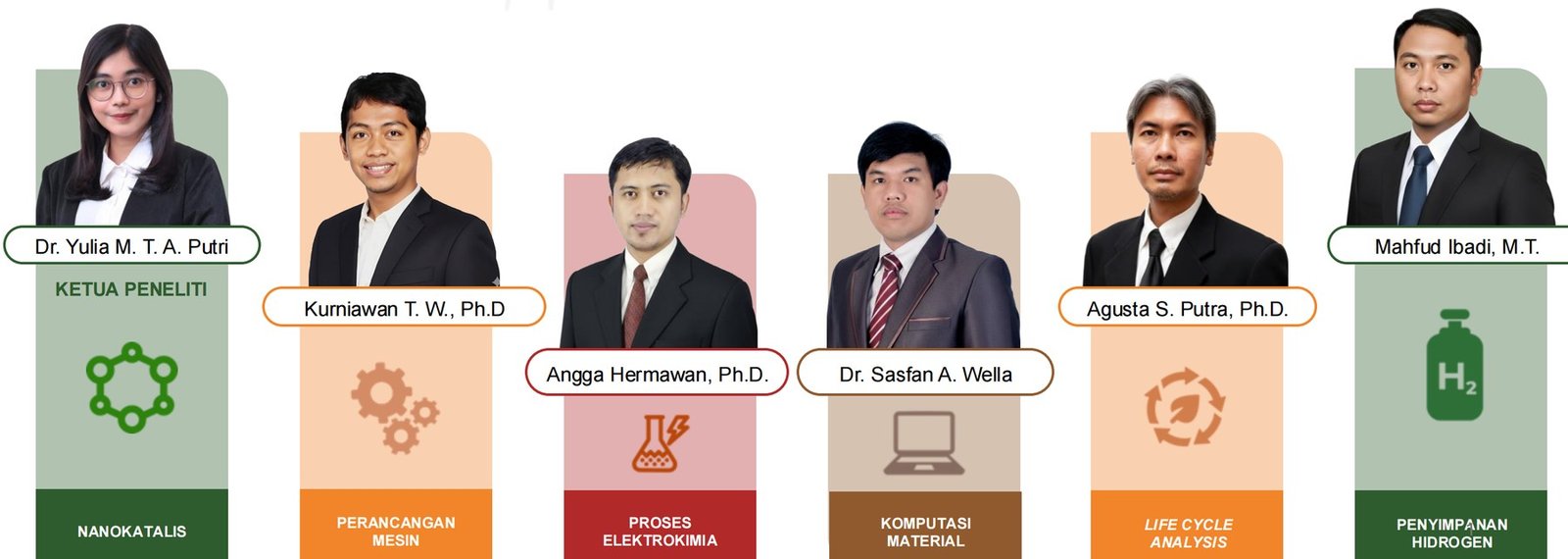
Six researchers from two institutions, each responsible for one part of the chain.
Lead institutionUniversitas Indonesia
Leads the project, makes the nickel alloy catalysts, and designs the flow cell.
- Dr. Yulia Mariana Tesa Ayudia Putri, principal investigatorDepartment of Chemistry. Catalyst synthesis and characterization.
- Kurniawan Teguh Waskito, S.T., M.T., Ph.D.Department of Mechanical Engineering. Engineering design and fluid dynamics of the flow cell.
Partner institutionNational Research and Innovation Agency (BRIN)
Tests the catalysts electrochemically, models the reactions, builds the hydrogen tank, and runs the life cycle assessment.
- Dr. Angga HermawanResearch Center for Nanotechnology System. Electrochemical testing of glycerol conversion and hydrogen production.
- Dr. Sasfan Arman WellaResearch Center for Quantum Physics. Computational materials science (DFT).
- Dr. Agusta Samodra PutraResearch Center for Sustainable Production System and Life Cycle Assessment. Life cycle and techno-economic assessment.
- Mahfud Ibadi, M.T.Research Center for Rocket Technology. Composite materials for hydrogen storage.
Planned outputs
Papers
Three papers in high-ranking international journals, one in each year of the project.
Patents
Four patent applications, covering the catalyst, the flow cell, the hydrogen tank, and the integrated system.
Prototypes
A flow cell with a 10 by 10 cm active area, a scaled-up flow cell, and a high-pressure hydrogen tank.
Interested in this project?
We welcome questions, joint work, and students who want to build on it.