
Materials and methods for sustainable electrochemistry
Electrochemistry can store renewable electricity, turn water, CO2, nitrogen compounds, and biomass into fuels and chemicals, and detect what matters for health and the environment. Our work covers the materials that make these reactions efficient, the sustainable sources they can be made from, and the tools to watch them at work.
Electrocatalysis for fuels and chemicals
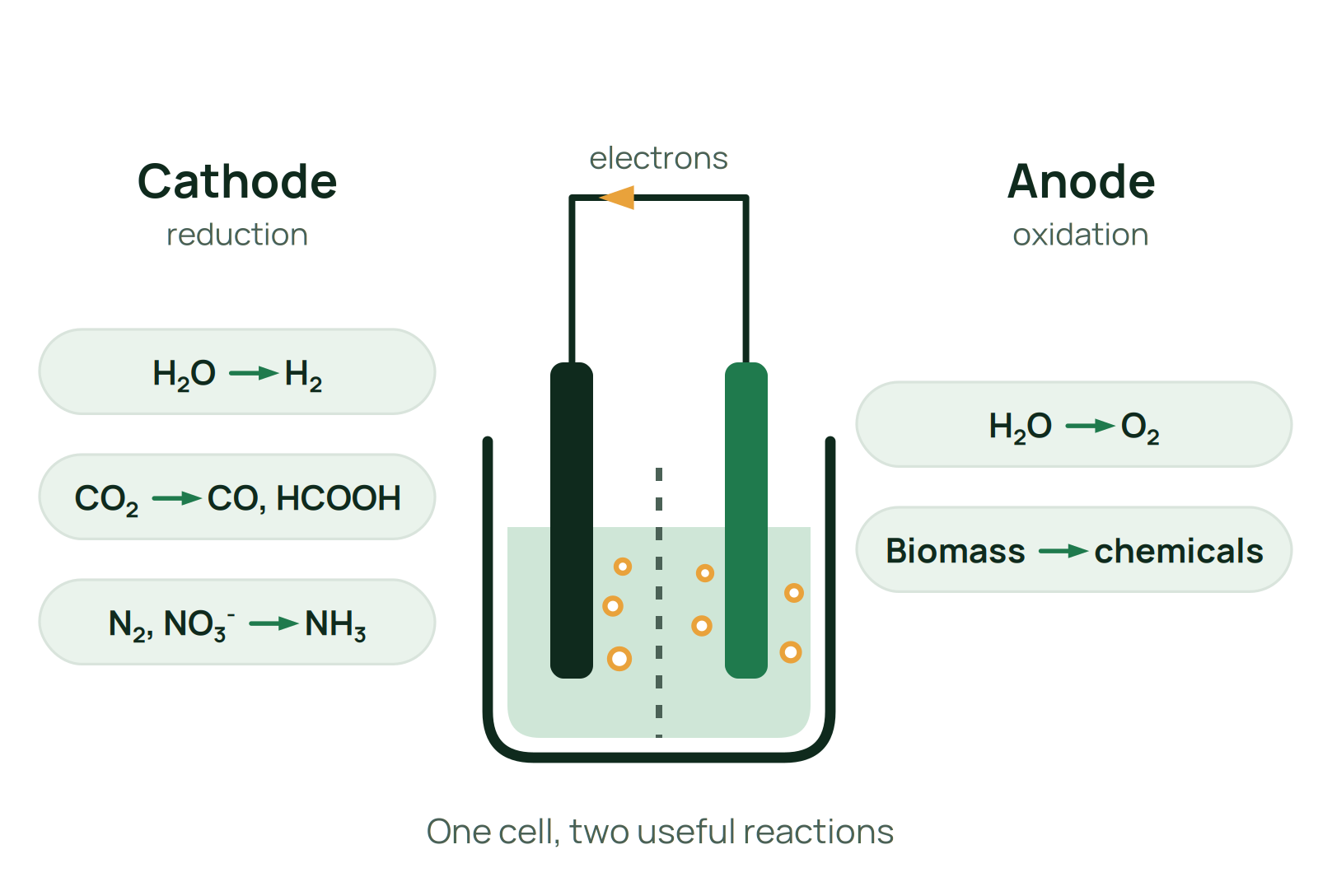
Renewable electricity can drive reactions that turn water, CO2, and nitrogen compounds into fuels and chemicals. We design catalysts for both electrodes. At the cathode we study hydrogen evolution, CO2 reduction, and the reduction of nitrogen, nitrate, and nitrogen oxides to ammonia. At the anode we study oxygen evolution and the oxidation of glycerol, glucose, and HMF, which may replace oxygen evolution with a reaction that yields a product of value.
- Cathode reactions for hydrogen, carbon products, and ammonia
- Anode reactions that pair biomass oxidation with hydrogen production
- Linking catalyst structure to selectivity
Key papers
Fundamentals, rational catalyst design, and remaining challenges in electrochemical NOx reduction reaction. iScience, 2023
Upcycling air pollutants to fuels and chemicals via electrochemical reduction technology. Journal of Environmental Management, 2023
Autonomous high-throughput computations in catalysis. Chem Catalysis, 2022
Energy storage
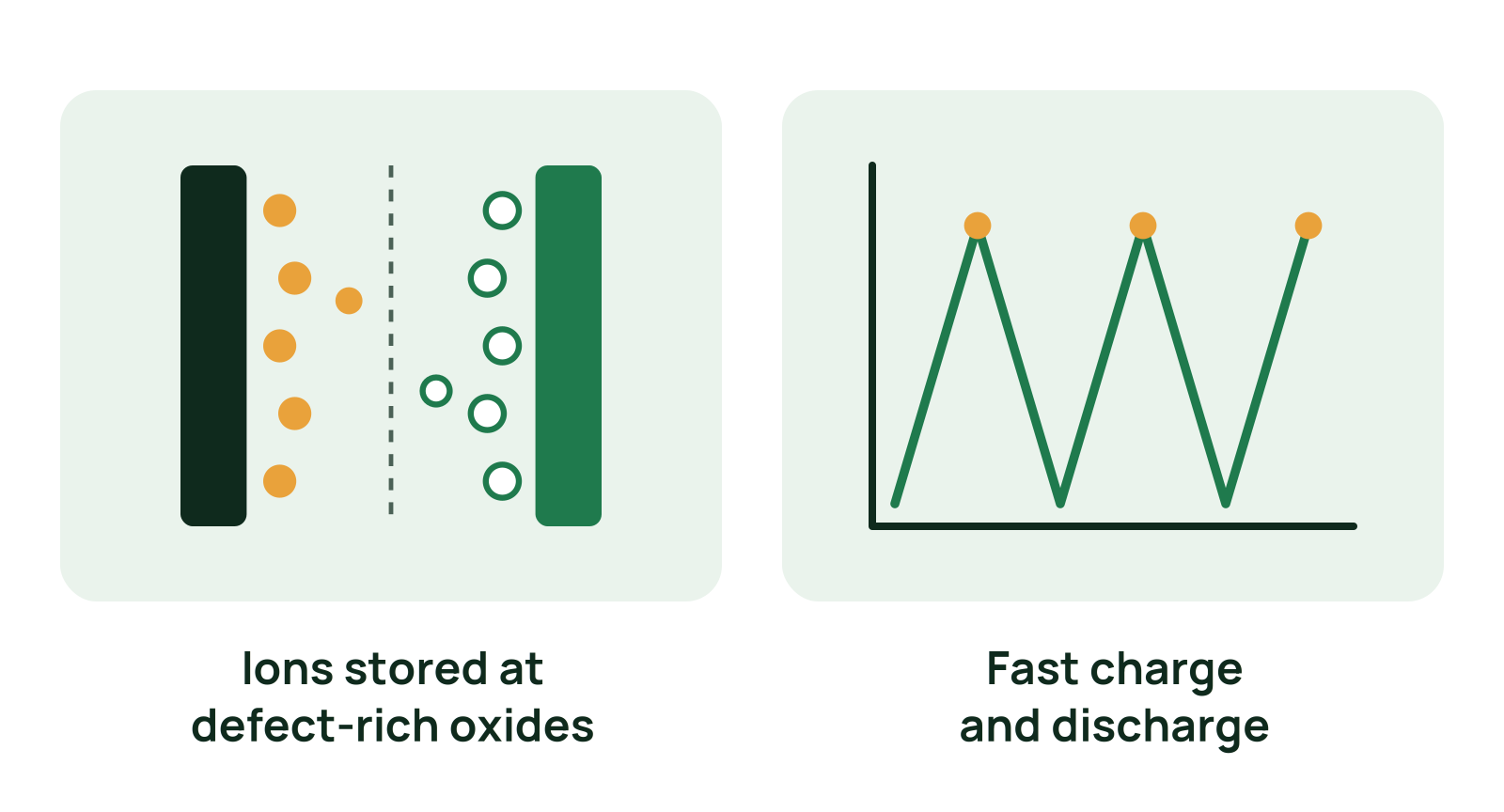
Defects decide how much charge an electrode can store and how fast it can release it. We study supercapacitor electrodes built on defect-rich metal oxides, conducting polymers, and biomass-derived carbon, and we examine how the electrolyte and its pH change their behaviour.
- Defect engineering in oxide electrodes for supercapacitors
- Biomass-derived activated carbon and its porosity
- Electrolyte and pH effects on charge storage
Key papers
Material design and characterization of conducting polymer-based supercapacitors. Polymer Reviews, 2024
High energy density asymmetric supercapacitors enabled by La-induced defective MnO2 and biomass-derived activated carbon. Materials Letters, 2023
Sustainable materials from waste
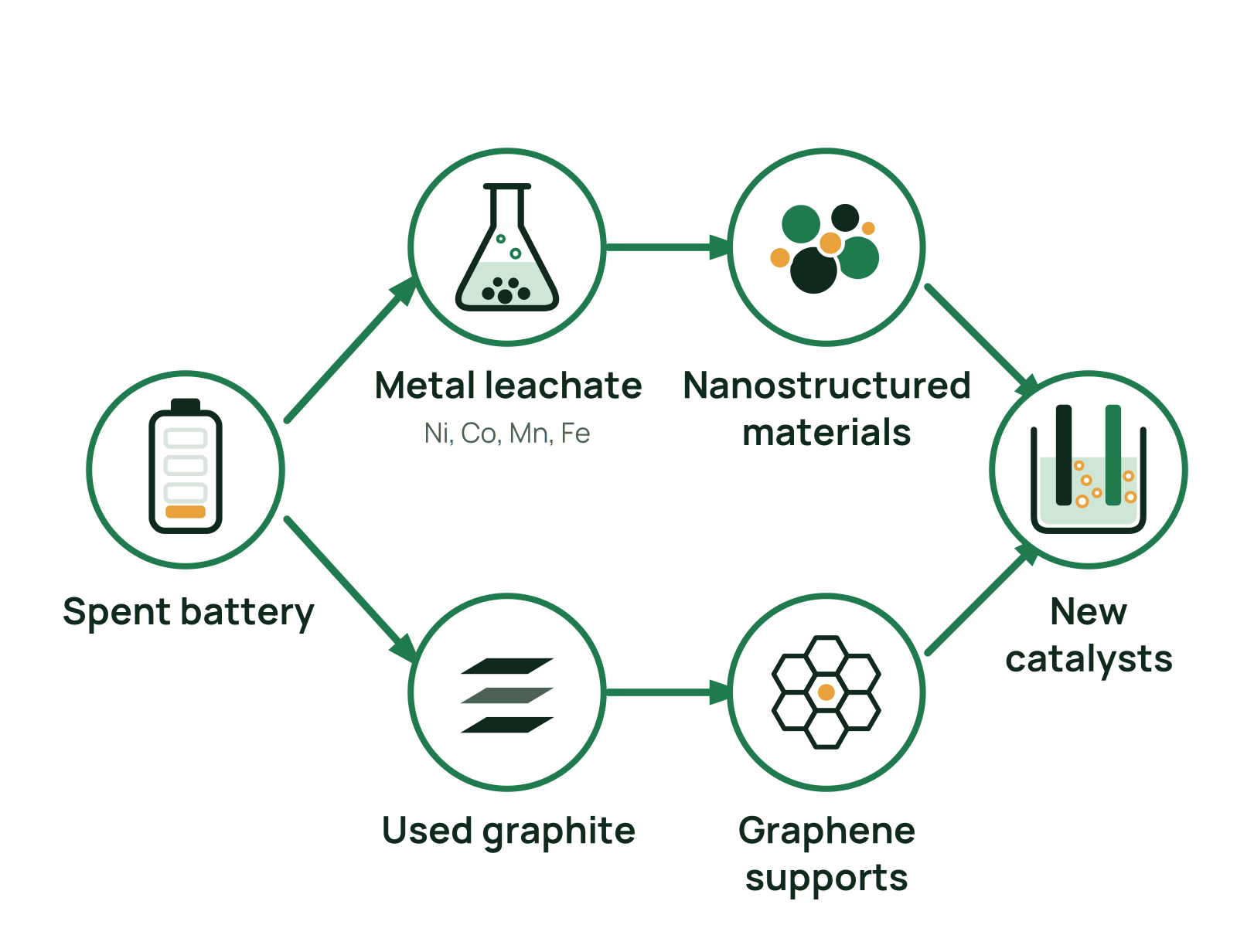
We treat waste as a feedstock. Spent lithium-ion batteries are usually recycled for their raw metals, and we take a shorter route. Cathode leachates and used graphite anodes are converted directly into nanostructured materials and carbon supports. The same thinking extends to biomass and industrial residues, which become activated carbons and catalyst precursors.
- Spent battery cathodes and anodes as sources of multi-metal catalysts and carbon supports
- Biomass and industrial waste as sources of carbon and catalysts
- Life cycle assessment to test whether upcycling routes lower environmental impact
Key papers
High-entropy layered oxide electrocatalyst derived from spent battery cathodes for overall water splitting and 2,5 hydroxymethylfurfural (HMF) oxidation. Materials Horizons, 2026
Quaternary layered double hydroxides from spent battery as electrocatalysts for the oxygen evolution reaction. International Journal of Hydrogen Energy, 2024
Chemical and electrochemical sensing
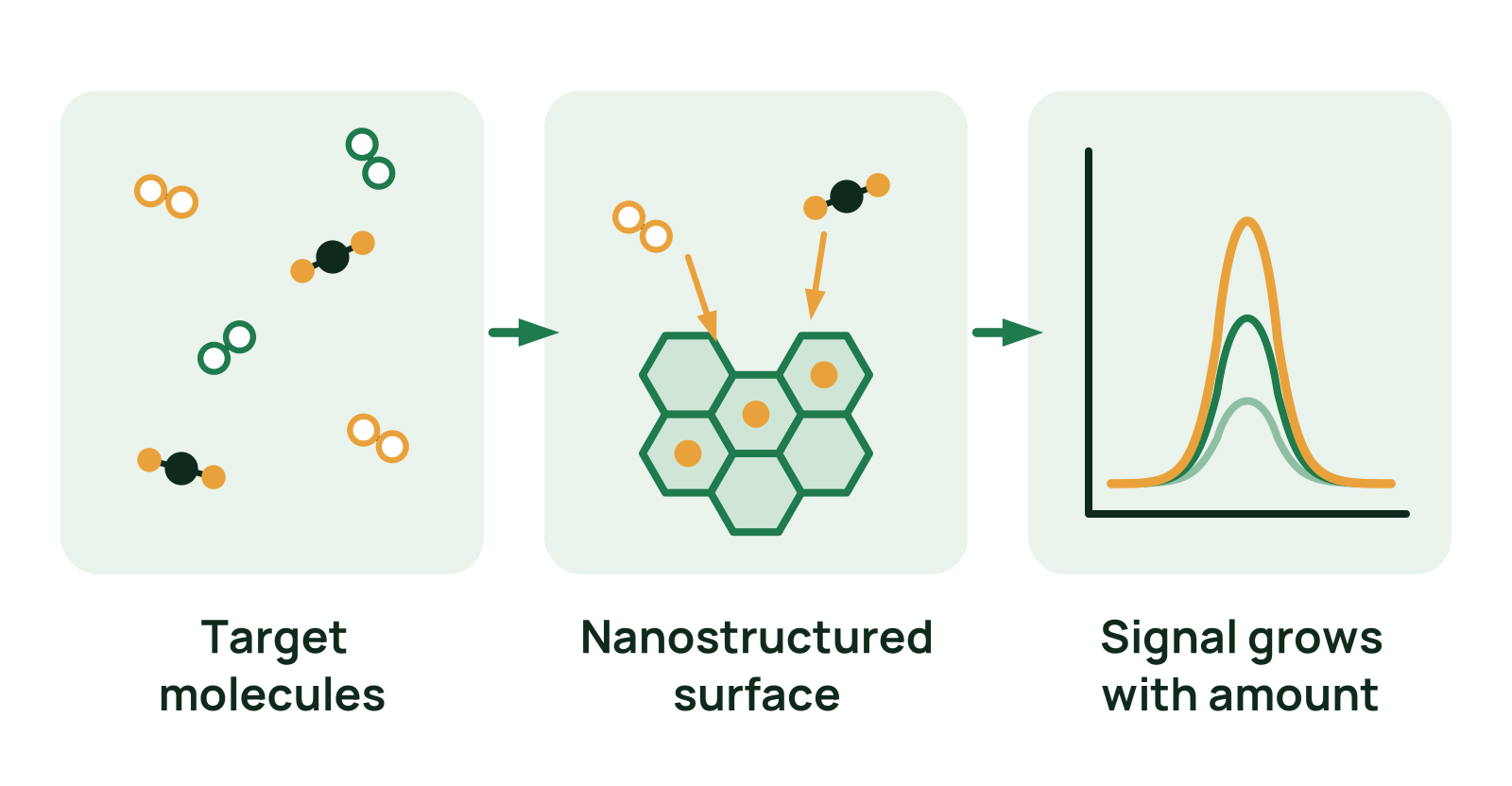
Sensing is where this research began. Earlier work on metal oxides and MXenes showed how surface structure controls the response to gases such as NO2, acetone, and toluene. The same thinking now guides electrochemical sensors for dopamine, pesticides, food antioxidants, and disease markers, where nanomaterial electrodes are tuned to detect targets at low concentrations.
- Gas sensors based on metal oxides and MXenes
- Non-enzymatic electrochemical sensors and immunosensors
- Two-dimensional materials for breath-based and point-of-care diagnostics
Key papers
Nanomaterial-based electrochemical sensors for phenolic antioxidants in foods and beverages. Methods, 2026
Achieving high-performance NO2 sensors via vertically-aligned Ti3C2Tx nanoarchitectures. Sensors and Actuators B: Chemical, 2025
Tailoring NiFeOx nanostructures with molten salts synthesis for non-enzymatic electrochemical sensing of dopamine. Journal of Solid State Electrochemistry, 2025
Advanced strategies to improve performances of molybdenum-based gas sensors. Nano-Micro Letters, 2021
Operando and in situ spectroscopy
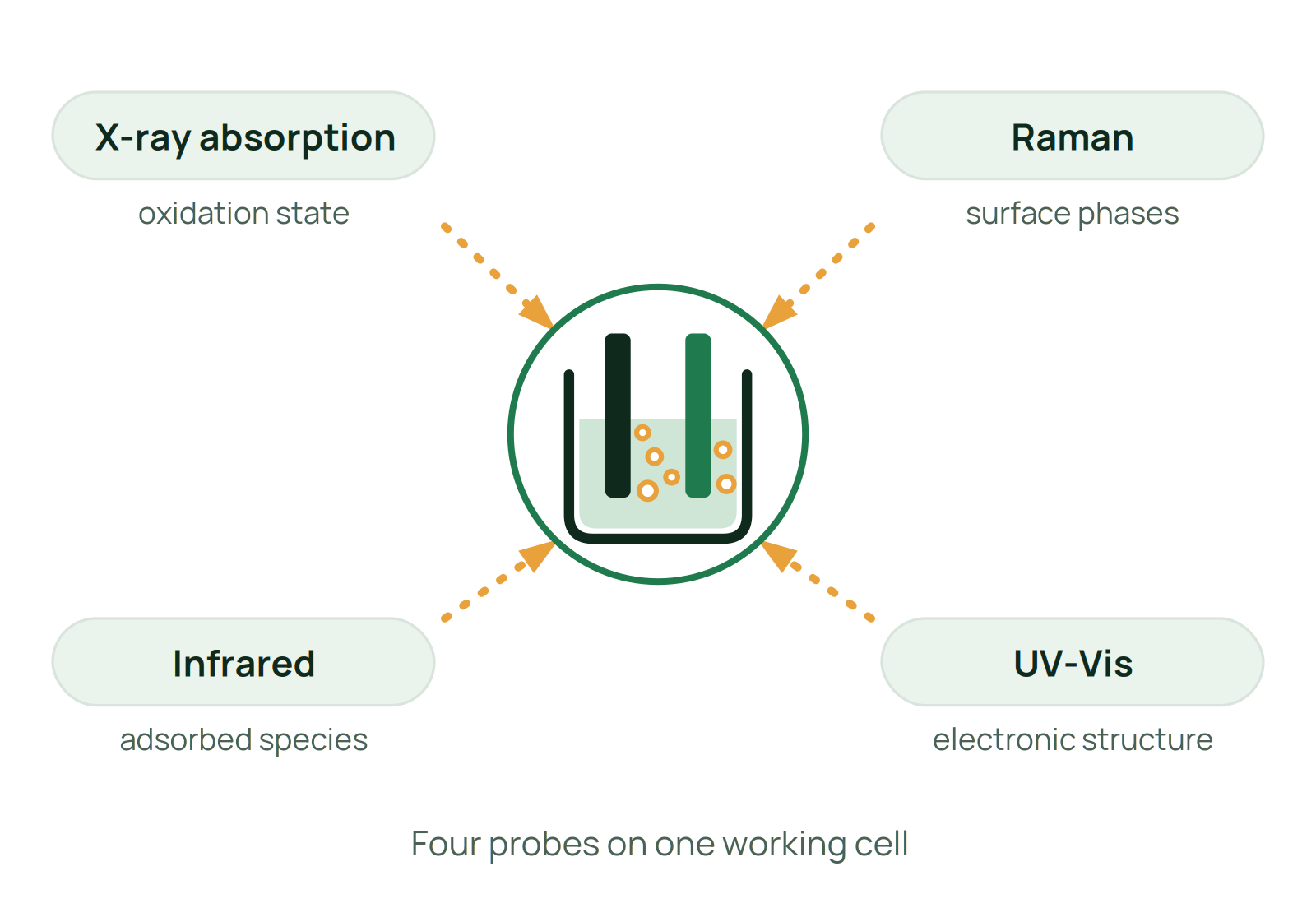
A catalyst or electrode rarely looks the same at work as it does on the bench. We follow materials while the reaction runs, combining synchrotron X-ray absorption and scattering with in situ Raman, infrared, and UV-Vis spectroscopy. Each probe answers a different question, from oxidation state and local structure to surface phases and adsorbed intermediates.
- Operando X-ray absorption spectroscopy and X-ray scattering at synchrotron facilities
- In situ Raman and infrared spectroscopy of surface phases and reaction intermediates
- In situ UV-Vis spectroscopy of electronic and optical changes during reaction
Key papers
Add papers that use operando or in situ methods.
AI and machine learning in electrochemistry
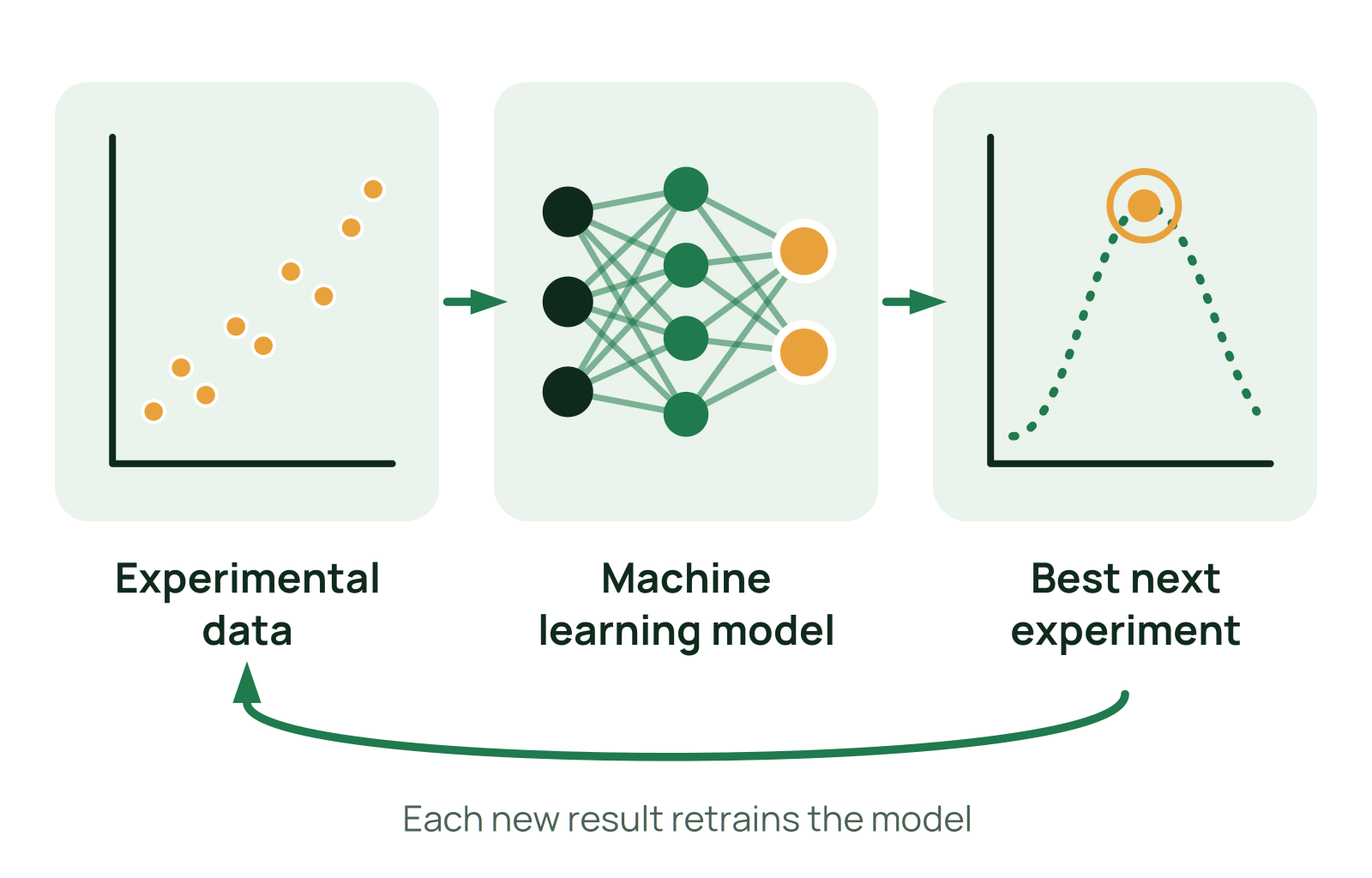
Electrochemical experiments produce more data than a person can read by eye. We use machine learning and automated computation to find patterns in that data, to screen candidate catalysts before they are made, and to make synthesis from variable waste feedstocks more reproducible.
- Machine learning models that link composition and structure to performance
- Automated, high-throughput computation for catalyst screening
- Data-driven control of synthesis from waste feedstocks, where every batch differs
Key papers
Autonomous high-throughput computations in catalysis. Chem Catalysis, 2022
Grants and projects
Our work is supported by national funding and by competitive international programmes that give access to advanced facilities.
Research grants
| Project | Funder | Period |
|---|---|---|
| RECO2VER. Utilizing industrial and biomass waste-derived catalysts for recycling CO2 into high-value energy resources | LPDP RIIM through the Southeast Asia-Europe Joint Funding Scheme | 2025 to 2028 |
| Two-dimensional materials as biomarker-based sensing materials towards point-of-care disease monitoring | LPDP RIIM, BRIN | 2023 to 2026 |
| Upcycling waste battery materials into electrocatalysts for tandem production of hydrogen and biomass conversion | NEDO and the Embassy of France | 2023 to 2025 |
| Waste batteries as electrocatalysts for green electrochemical processes | STIC Research and Publishing Grant | 2024 |
| Tandem electrocatalysts for hydrogen production and biomass valorization, with CNRS-IRCELYON | Science et Impact, Institut francais d'Indonesie and the Embassy of France | 2024 |
Facility access and beamtime
| Programme | What it supports | Host | Period |
|---|---|---|---|
| ReMade@ARI | Laser processing, in situ electrochemistry, and electron microscopy | CLL, Coimbra and NIMP, Bucharest | 2026 |
| RISEnergy Transnational Access | Research stay on energy materials | Karlsruhe Institute of Technology | To be scheduled |
| EXCITE | Atomic force and electron microscopy | University of Granada | To be scheduled |
| EMERGE | Sustainable printable electronics using recycled battery materials | RISE, Norrkoping | 2026 |
| Synchrotron Light Research Institute | X-ray scattering and operando X-ray absorption spectroscopy | SLRI, Thailand | 2026 |
| ISIS Neutron and Muon Source | Neutron scattering on the MAPS and TOSCA instruments | ISIS, United Kingdom | 2024 |